A maintenance bond is a surety bond guaranteeing the contractor will repair defects in materials and workmanship found after acceptance, typically for 2 years, with penal sums from 15% to 100% of the work in public rules.
Key takeaways
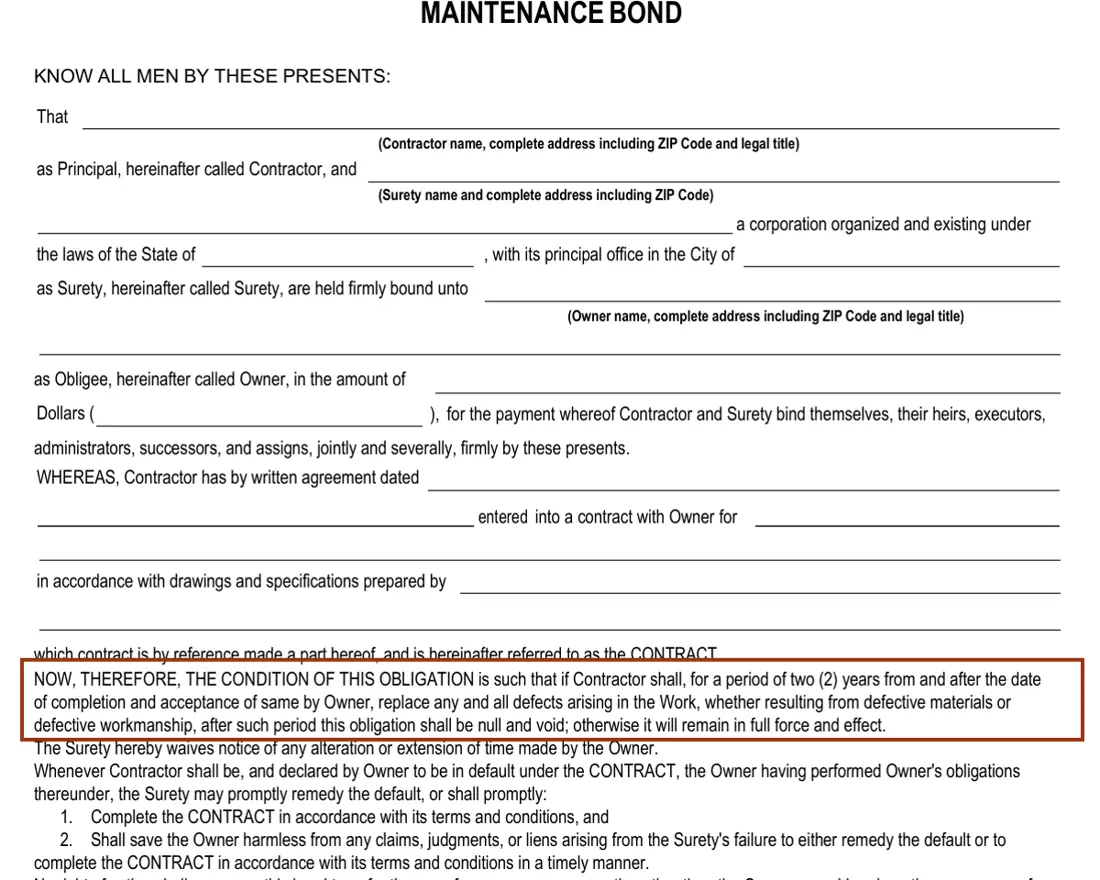
- A maintenance bond (also called a warranty bond) starts when the owner accepts the work: the West Virginia Purchasing Division maintenance bond form (approved July 15, 2024) binds the surety for 2 years “from and after the date of completion and acceptance.”
- Public penal sums run from 15% to 100%: Oregon City, Oregon asks for 15% of construction cost, Independence, Ohio §158.26 20% of the contract price, and the NCDOT asphalt surface treatment warranty 100% of the bid for the warranted items.
- State subdivision laws cap what a town may demand: New Jersey allows at most 15% for at most 2 years (N.J.S.A. 40:55D-53), Pennsylvania at most 15% for at most 18 months (MPC §509(k)).
- The one-year period in AIA A201-2017 §12.2.2.1 is the contractor’s own duty to correct work, with no surety behind it; a maintenance bond adds a surety that must fix or pay if the contractor does not.
- The Ohio Department of Transportation reported in 2007 that warranty bonds cost 0.5% to 1% of the warranted item, and contractors quoted 0.9% for asphalt paving ($40,000 on $4.4 million) (ODOT warranty program report).
What is a maintenance bond in construction?
A maintenance bond is a three-party guarantee that covers the period after the owner accepts the work. The contractor (principal) and a surety company promise the owner (obligee) that defects from faulty materials or workmanship will be corrected during a fixed term, most often 2 years. If the contractor does not correct a defect after notice, the surety must fix it or pay, up to the penal sum written on the bond.
| Party or term | Who or what | What the bond form says | Source |
|---|---|---|---|
| Principal | The contractor or developer that built the work | Must “replace any and all defects arising in the Work” for 2 years after acceptance | WV Purchasing Division form |
| Surety | The bonding company | Corrects defects and pays city costs on 45 days written notice of default | City of New Braunfels, TX form |
| Obligee | The owner or public agency | Only the owner named on the bond has a right of action | WV Purchasing Division form |
| Penal sum | The most the surety can owe | A dollar amount the agency sets, often a percent of contract or improvement cost | Agency table below |
| Term | The coverage window | 2 years from written acceptance by the City Engineer | City of New Braunfels, TX form |
“Maintenance bond” and “warranty bond” name the same instrument in most public documents. The Ohio Department of Transportation calls the bond behind its pavement warranties a “maintenance bond” and pays its premium under the pay item “Premium for Contract Performance Bond, Payment Bond and Maintenance Bond,” per its 2007 warranty program report. The NCDOT special provision calls the same product a “warranty bond.”
This page summarizes public bond forms, statutes, specifications and agency reports read in November 2026. It is not legal, bonding or insurance advice: the bond and contract on your job control, and a construction attorney or surety agent can tell you how a given form reads in your state.
Who requires a maintenance bond, and for how much?
Public owners require most maintenance bonds, in two settings: public works contracts (the city or state is the owner) and private developments that dedicate streets, utilities or stormwater systems to a city. No federal statute requires one. The 8 public requirements below set penal sums from 15% to 100% and terms from 18 months to 7 years, and two states cap what municipalities may demand from developers.
| Agency or law | Applies to | Penal sum | Term | Starts | Source |
|---|---|---|---|---|---|
| City of Oregon City, Oregon | Public infrastructure built with a development | 15% of material and construction cost | 2 years | City acceptance | Engineering maintenance bond page |
| City of Independence, Ohio, Codified Ordinance §158.26 | City public improvement contracts | 20% of total contract price | 2 years (or as the contract states) | City Engineer or Service Director approves the final estimate | §158.26 (Ord. 2003-13) |
| City of New Braunfels, Texas | Subdivision site work, streets, drainage, water, wastewater, electric | Dollar amount from the approval memo and cost estimate | 2 years, plus a new 1-year bond for any corrected defect | Written acceptance by the City Engineer | Maintenance bond form |
| West Virginia Purchasing Division | State agency contracts that call for the bond | Dollar amount entered on the form | 2 years | Completion and acceptance by the owner | Form approved by the Attorney General 07-15-2024 |
| Pennsylvania Municipalities Planning Code §509(k) | Improvements a municipality accepts for dedication | Not more than 15% of actual installation cost | Not more than 18 months | Acceptance of dedication | Act 247 of 1968, as amended 2012 |
| New Jersey, N.J.S.A. 40:55D-53(a)(2) | Developer improvements and private stormwater basins | Not more than 15% of installation cost | Not more than 2 years, then expires automatically | Before release of the performance guarantee | Statute text |
| North Carolina DOT, Warranty of Asphalt Surface Treatment | Asphalt surface treatment (chip seal) items | 100% of the amount bid for the warranted items | 2 years | Completion date | Special provision R6 R56, rev. 11-21-06 |
| Ohio DOT under Ohio Revised Code 5525.25 | Warranted pavement, bridge deck and paint items | Amount of the warranted item (report also states 30% to 90% by bid size) | Up to 2, 5 or 7 years by work type | Per specification | 2006 Status of the Warranty Program, Feb. 1, 2007 |
Virginia shows a third pattern. Under Va. Code §15.2-2241, a county may require a “maintenance and indemnifying bond” from a developer whose finished road is not yet accepted into the state secondary system, sized to keep the road maintained until the Virginia Department of Transportation accepts it. The term there ends at acceptance, not at a fixed number of years.
How long does a maintenance bond last?
Most public maintenance bonds run 2 years from the owner’s written acceptance, the term used by Oregon City, Independence, New Braunfels, the West Virginia Purchasing Division and NCDOT. Pennsylvania caps the term at 18 months. Longer terms appear on state DOT performance warranties: Ohio Revised Code 5525.25 allows up to 5 years for resurfacing and up to 7 years for new pavement.
The start date matters more than the length. Under AIA A201-2017 the one-year correction period starts at Substantial Completion (§12.2.2.1), while the West Virginia and New Braunfels bonds start at final acceptance, which can come weeks or months later. On a public job, the bond clock and the contract correction clock can therefore run on different dates; our guide to substantial completion and the G704 certificate sets out what starts on that date.
A corrected defect can restart coverage for that item. The New Braunfels form requires “a new maintenance bond or surety instrument” for “one full calendar year” covering each corrected defect. A201-2017 §12.2.2.3 says the reverse for the contract duty: corrective work does not extend the one-year correction period. The FHWA short-term pavement warranty notes list 2 to 4 years as the usual period for materials and workmanship warranties on hot-mix asphalt.
How is a maintenance bond different from a performance bond, a payment bond and the A201 correction period?
A performance bond guarantees the contractor finishes the job; a payment bond guarantees subcontractors and suppliers get paid; a maintenance bond guarantees repairs after acceptance. The AIA A201 correction period is a fourth thing: a contract promise by the contractor alone, with no surety. On federal work, the Standard Form 25 performance bond already reaches into the guaranty period, so a separate maintenance bond is unusual there.
| Instrument | Protects | Covers | Typical amount | Ends | Source |
|---|---|---|---|---|---|
| Performance bond | Owner | Completion of the contract | 100% of contract price on federal jobs over $150,000 | Completion; SF 25 also covers the life of any guaranty the contract requires | Standard Form 25 (Rev. 10/2023) |
| Payment bond | Subcontractors and suppliers | Unpaid labor and material bills | 100% of contract price on federal jobs over $150,000 | Claim deadlines run from last work | CB&C performance bond guide |
| Maintenance (warranty) bond | Owner | Defects in materials and workmanship after acceptance | 15% to 100% in the agency table above | End of term, often 2 years after acceptance | WV, New Braunfels, NCDOT forms |
| A201-2017 §12.2.2.1 correction period | Owner | Work found not in accordance with the Contract Documents | No penal sum; contractor’s own balance sheet | 1 year after Substantial Completion | AIA A201-2017 |
| A201-2017 §3.5 warranty | Owner and Architect | Materials new and of good quality, work free from defects | No penal sum | No fixed end in §3.5; §12.2.5 says the 1-year period does not limit it | AIA A201-2017 |
The practical gap is the surety. Under A201 §12.2.2.1, a contractor that has closed its doors cannot correct anything, and the owner’s remedy is a claim against a company with no assets. A maintenance bond puts a surety with its own balance sheet behind the same promise, up to the penal sum. A201 §11.1.2 requires the contractor to provide bonds “of the types, for such penal sums” as the Contract Documents state, so a private owner who wants one must write it into the agreement or the specifications.
A201 also sets a notice trap. If the owner fails to notify the contractor and give it a chance to correct during the one-year period, §12.2.2.1 says the owner waives the right to require correction and to claim for breach of warranty. Bond forms carry their own notice rules, covered in the claim section below. How the A201 sections fit together is in our AIA A201 general conditions guide.
How does a maintenance bond claim work?
A claim starts with written notice to the contractor, not to the surety. The owner names the defect and gives a reasonable time to correct it; only if the contractor fails does the owner declare a default and call on the surety. On the New Braunfels form the surety must act within 45 days of written notice and pays construction, engineering and legal costs; the West Virginia form lets only the named owner sue.
- Find and document the defect inside the term. Photograph it, date it and tie it to the specification section. On a 2-year bond accepted June 1, 2026, the last day of coverage is May 31, 2028.
- Send written notice to the contractor. The New Braunfels form requires the City Engineer to name each defect and “a reasonable period of time” to correct it; A201 §12.2.2.1 asks the owner to give notice “promptly after discovery.”
- Wait out the cure period. If the contractor corrects the defect, the claim ends; New Braunfels then requires a new 1-year bond on the corrected item.
- Declare the default and notify the surety in writing. The New Braunfels form gives the surety 45 days from written notice to correct the defect.
- Let the surety choose its remedy. On the West Virginia form, the surety may remedy the default or complete the contract and hold the owner harmless from claims caused by its delay.
- If the surety refuses, fix the defect and recover, or sue. The New Braunfels form lets the city correct the defect itself and recover the full cost from both the principal and the surety, jointly and severally.
Three details trip owners up. The surety waives notice of time extensions on the West Virginia form, so a late completion does not void the bond. Subcontractors cannot claim, because the West Virginia form gives no right of action to anyone but the owner. On private jobs, the performance bond claim steps in our performance bond guide are a closer model than the payment bond rules.
How much does a maintenance bond cost?
The most detailed government cost data comes from the Ohio Department of Transportation. Its February 2007 warranty program report found warranty bonds cost 0.5% to 1% of the warranted item, contractors quoted 0.9% for asphalt paving ($40,000 on $4.4 million of work), and ODOT’s own estimates came to about 0.90% of warranted work in both 2004 and 2005. The contractor buys the bond and prices it into the bid.
| Measure | Figure | Year | Scope | Source |
|---|---|---|---|---|
| Warranty bond cost, bonding companies and contractors surveyed | 0.5% to 1% of the warranted item | 2006 review | Ohio DOT warranted items | ODOT report, Feb. 1, 2007 |
| Normal bonding rate for asphalt paving | 0.9% ($40,000 for $4.4 million of work) | 2006 review | Ohio asphalt paving contractors | ODOT report |
| ODOT warranty bond payment estimate | $643,104 on $71,455,965 of warranted work (0.90%) | 2004 | Asphalt, bridge deck, pavement maintenance | ODOT report, CB&C division |
| ODOT warranty bond payment estimate | $555,950 on $61,772,225 of warranted work (0.90%) | 2005 | Asphalt, bridge deck, concrete, pavement maintenance | ODOT report, CB&C division |
| Rates filed with the Ohio Department of Insurance, painting | 0.05% to 10% | 2006 review | Bridge painting warranties | ODOT report |
| Performance bond rates reported by highway contractors (contrast) | 0.22% to 2.5%; average 0.79% | 2014 report | Performance bonds, not maintenance bonds | FHWA-HRT-14-034, ch. 4 |
Two cost drivers show up in the ODOT report. First, layering: when the prime contractor makes its paving subcontractor carry a matching bond, ODOT said this “in effect will double the bond cost,” because the owner pays both premiums through the bid. Second, the penal sum: a bond written at 100% of the warranted item, as NCDOT requires for chip seal, carries a larger premium than one capped at 15% under the New Jersey or Pennsylvania statutes. The rates are percentages from 2006, so they do not need inflation adjustment, but surety pricing has changed since and a current quote controls.
Worked example: a maintenance bond on a commercial site paving job
Take a hypothetical $640,000 contract to mill, repair base and overlay a retail center’s parking lot and drive aisles, with a 2-year maintenance bond in the specifications. The penal sum depends on the rule the owner copies: 15%, 20% or 100% of the contract. At the ODOT 0.5% to 1% range, the premium runs from $480 to $6,400; this is CB&C arithmetic, not a quote.
| Penal sum rule (model) | Penal sum on $640,000 | Premium at 0.5% | Premium at 0.9% | Premium at 1.0% |
|---|---|---|---|---|
| 15% (Oregon City; NJ and PA caps) | $96,000 | $480 | $864 | $960 |
| 20% (Independence, Ohio §158.26) | $128,000 | $640 | $1,152 | $1,280 |
| 100% (NCDOT surface treatment) | $640,000 | $3,200 | $5,760 | $6,400 |
| 100%, prime and paving sub both bonded (ODOT “double” case) | $640,000 twice | $6,400 | $11,520 | $12,800 |
The arithmetic applies ODOT’s rate to the penal sum, which matches ODOT’s own case, where the bond equals the warranted item. Sureties may price small bonds at a higher percentage or set a minimum premium, so the 15% and 20% rows are floors. What the owner buys also differs: at 15%, a surety owes at most $96,000, enough for patching and a partial overlay but not a full replacement of the lot. If the paved area fails in year 1 from a base problem, the 100% bond covers the full $640,000 scope; the 15% bond leaves $544,000 of exposure with the contractor’s own balance sheet.
Retainage is the cash alternative some owners use instead. Holding 5% of $640,000 for 2 years ties up $32,000 of the contractor’s cash for the whole term, against a premium of $864 to $1,152 at a 15% to 20% penal sum and the 0.9% rate; state limits on how long public owners may hold it are in our retainage guide. Defects found before final payment belong on the punch list, which closes before the bond term begins.
Which maintenance bond terms should an owner ask for?
Match the bond to the risk and the rules that bind you. A public owner follows its code or statute; a developer dedicating streets follows the municipality’s caps; a private owner sets terms in the contract. The decision table below gives the thresholds and the clause to use in each case, drawn from the agency documents above.
| If | Then | Source |
|---|---|---|
| You are a New Jersey or Pennsylvania municipality taking dedicated improvements | Ask for no more than 15%; term no more than 2 years (NJ) or 18 months (PA) | N.J.S.A. 40:55D-53; MPC §509(k) |
| You are a private owner on AIA A201 with no bond in the specs | You have only the 1-year §12.2.2.1 correction duty; add the bond type, penal sum and term to the Contract Documents under §11.1.2 | AIA A201-2017 |
| The work is paving, chip seal or other surface work that fails in the first 2 years | Consider 100% of the warranted items for 2 years, as NCDOT does | NCDOT R6 R56 |
| You want a warranty longer than 2 years | Expect a performance-warranty spec: ODOT allows up to 5 years for resurfacing and 7 for new pavement, with bonds of 30% to 90% | ORC 5525.25; ODOT report |
| The prime contractor will also bond its paving subcontractor | Expect roughly double the premium in the bid; decide whether you need both | ODOT report |
| A defect is corrected during the term | Require a new 1-year bond on the corrected item, as New Braunfels does | New Braunfels form |
| The job is federal | Check the SF 25 performance bond: it already covers the life of any contract guaranty; FAR 52.246-21 runs its warranty 1 year from final acceptance | SF 25; FAR 52.246-21 |
Write four things into the specification: the penal sum as a percent and a dollar figure, the start event (Substantial Completion or final acceptance), the term in months, and the notice address and cure period. The West Virginia and New Braunfels forms are public templates that show all four. Other bond types a job may need, from bid to payment bonds, are listed in our construction surety bonds overview.
It follows the performance bond and payment bond on public jobs, and covers the construction warranty period.
How we compiled this
We read 13 primary documents in October and November 2026: 3 public bond forms (West Virginia Purchasing Division, City of New Braunfels, Oregon City), 1 city ordinance (Independence, Ohio), 3 state laws (Pennsylvania MPC, N.J.S.A. 40:55D-53, Va. Code §15.2-2241), 2 state DOT documents (NCDOT, Ohio DOT with ORC 5525.25), 2 FHWA publications, AIA A201-2017 and Standard Form 25. Municipal requirements that we saw only in search summaries and could not open at the source were left out. Premium figures come only from the Ohio DOT report and FHWA; the worked example is CB&C arithmetic.
Frequently asked questions
Is a maintenance bond the same as a warranty bond?
Yes, in most public documents the two names describe one instrument: a surety bond guaranteeing correction of defects after acceptance. The Ohio Department of Transportation calls the bond behind its pavement warranties a maintenance bond, while the North Carolina DOT chip seal specification calls the same product a warranty bond, set at 100% of the warranted items for 2 years.
Who pays for a maintenance bond?
The contractor or developer buys the bond and pays the premium, then prices it into the bid, so the owner pays indirectly. Ohio DOT paid the premium through the pay item Premium for Contract Performance Bond, Payment Bond and Maintenance Bond, and its 2007 report estimated $643,104 in warranty bond payments on $71,455,965 of warranted work in 2004.
How long is a maintenance bond good for?
Most public maintenance bonds run 2 years from written acceptance, the term on the West Virginia Purchasing Division and New Braunfels, Texas forms. Pennsylvania caps municipal maintenance security at 18 months under MPC section 509(k), and New Jersey at 2 years. Ohio Revised Code 5525.25 allows state DOT warranties of up to 7 years for new pavement.
What is the difference between a performance bond and a maintenance bond?
A performance bond guarantees the contractor finishes the contract, usually at 100% of the price; a maintenance bond guarantees repairs of defects after acceptance, at 15% to 100% in the public rules we read. Federal Standard Form 25 performance bonds already extend through the life of any guaranty the contract requires, so a separate maintenance bond is rare on federal work.
Does fixing a defect extend the maintenance bond?
It depends on the form. The City of New Braunfels, Texas form requires a new maintenance bond for one full calendar year covering each corrected defect. AIA A201-2017 section 12.2.2.3 takes the opposite approach for the contract duty: corrective work does not extend the one-year correction period. Write the rule you want into the specification before bidding.
How much is a maintenance bond on a $1 million contract?
At the 0.5% to 1% range the Ohio DOT reported for warranty bonds in 2007, about $5,000 to $10,000 if the penal sum equals the full $1 million. At a 15% penal sum of $150,000, the same rates give $750 to $1,500, though sureties may charge more on small bonds. Treat these as CB&C arithmetic, not a quote.
Sources
- Maintenance Bond form (approved AG 07-15-2024), West Virginia Purchasing Division, accessed 2026-11-15.
- Maintenance Bond Form page, City of Oregon City, Oregon, Public Works Engineering, accessed 2026-11-15.
- Codified Ordinances §158.26, Guaranty of materials and workmanship, City of Independence, Ohio (American Legal Publishing), accessed 2026-11-15.
- Maintenance Bond form, City of New Braunfels, Texas, accessed 2026-11-15.
- Pennsylvania Municipalities Planning Code, Act 247 of 1968, §509(k), Pennsylvania General Assembly, accessed 2026-11-15.
- N.J.S.A. 40:55D-53, Guarantees required, statute text via FindLaw, accessed 2026-11-15.
- Code of Virginia §15.2-2241, Virginia Legislative Information System, accessed 2026-11-15.
- Warranty of Asphalt Surface Treatment, special provision R6 R56 (rev. 11-21-06), North Carolina Department of Transportation, accessed 2026-11-15.
- 2006 Status of the Warranty Program (Feb. 1, 2007), incl. Appendix A, ORC 5525.25, Ohio Department of Transportation, accessed 2026-11-15.
- Short-Term Pavement Warranties Program for HMA, Cliff Notes, Federal Highway Administration, accessed 2026-11-15.
- FHWA-HRT-14-034, Chapter 4, Benefit-Cost Analysis of Performance Bonds (August 2014), Federal Highway Administration, accessed 2026-11-15.
- AIA Document A201-2017, General Conditions (sample), The American Institute of Architects, posted by the University of Maine System, accessed 2026-11-15.
- Standard Form 25, Performance Bond (Rev. 10/2023), U.S. General Services Administration, accessed 2026-11-02.
- FAR 52.246-21, Warranty of Construction, Acquisition.gov, accessed 2026-10-19.