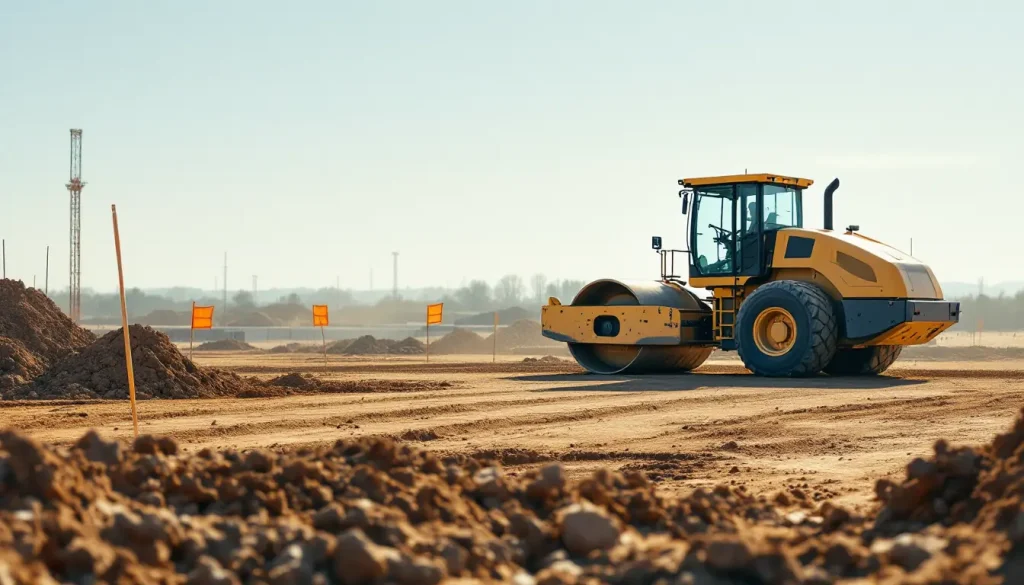
A compaction test compares the dry density of a compacted fill lift, read in the field by nuclear gauge or sand cone, with the lab maximum from a Proctor test: commercial pads usually need 90 to 95 percent.
Key takeaways
- Percent compaction is field dry density divided by lab maximum dry density, times 100: a lift at 105.7 lb/ft3 against a 111.3 lb/ft3 standard is 95 percent (WAQTC FOP for AASHTO T 310, WSDOT Materials Manual, January 2026).
- The modified Proctor (ASTM D1557) uses a 10 lb rammer dropped 18 in on 5 layers, about 4.5 times the 12,375 ft-lb/ft3 of the standard test (ASTM D698) (WAQTC FOP for AASHTO T 99/T 180).
- The federal earthwork guide spec asks for 90 percent of lab maximum for cohesive structural fill and 95 percent for cohesionless fill, in loose lifts of 8 in or less (UFGS 31 00 00, August 2023).
- Its default test rate is one density test per 2,000 sq ft of each lift, doubled where hand tampers do the compacting, plus one Proctor per 500 cubic yards of fill (UFGS 31 00 00 Table 1).
- Public rate sheets price a Proctor at $140 to $288 and a field density test at $28 to $34 each, plus a technician at $55 to $129 an hour (Utah DFCM, July 2026; City of Hidalgo, Texas, 2022).
What is a compaction test?
A compaction test is a pair of measurements. A lab compacts samples of the fill at rising moisture contents to find its maximum dry density and optimum moisture (the Proctor test). A field technician then reads the density and moisture of each compacted lift on site and reports it as a percentage of that lab maximum. The specification sets the minimum percentage and often a moisture window around optimum.
Under the 2024 International Building Code, a special inspector verifies “materials, densities and lift thicknesses during placement and compaction of compacted fill” on a continuous basis (IBC Section 1705.6 and Table 1705.6). Our guide to special inspections covers who hires that inspector and what the full program costs. The numbers below are the ones a commercial owner or builder meets most often.
| Item | Value | Source |
|---|---|---|
| Standard Proctor energy | 12,375 ft-lb/ft3 (ASTM D698 / AASHTO T 99) | WAQTC FOP T 99/T 180, Table 2 |
| Modified Proctor energy | 56,250 ft-lb/ft3 (ASTM D1557 / AASHTO T 180) | WAQTC FOP T 99/T 180, Table 2 |
| Nuclear gauge depth, direct transmission | Up to 12 in | ASTM D6938-23, section 1.2 |
| Sand cone limit | No appreciable rock over 1 1/2 in; hole up to 0.1 ft3 | ASTM D1556/D1556M-24, sections 1.2 and 1.5 |
| Structural fill target | 90% cohesive, 95% cohesionless | UFGS 31 00 00, 3.6.2 |
| Fill 12 in or less under footings, no geotechnical report | At least 90% of ASTM D1557 | IBC Section 1804.6 exception |
| Texas embankment, PI 15 or less | At least 98% of Tex-114-E maximum | TxDOT Item 132, Table 2 |
Standard or modified Proctor: which lab test does your spec call for?
Your specification names one of two lab tests, and the choice changes the target. ASTM D698 (standard Proctor) drops a 5.5 lb rammer 12 in onto 3 layers; ASTM D1557 (modified Proctor) drops a 10 lb rammer 18 in onto 5 layers. The modified test packs in about 4.5 times the energy, so 95 percent of a D1557 maximum is a denser, harder target than 95 percent of a D698 maximum.
The UFGS 31 00 00 designer note says to use ASTM D698 “for most projects” and ASTM D1557 “for roads, airfields, and other heavily loaded areas,” and to name one method per contract where possible (UFGS 31 00 00, paragraph 3.6.6 note). The ASTM D698 and ASTM D1557 titles round the energies to 12,400 and 56,000 ft-lb/ft3.
| Setting | Standard (ASTM D698 / AASHTO T 99) | Modified (ASTM D1557 / AASHTO T 180) | Source |
|---|---|---|---|
| Rammer mass | 5.5 lb | 10 lb | WAQTC FOP T 99/T 180 |
| Drop height | 12 in | 18 in | WAQTC FOP T 99/T 180 |
| Layers | 3 | 5 | WAQTC FOP T 99/T 180 |
| Blows per layer | 25 (4 in mold), 56 (6 in mold) | 25 (4 in mold), 56 (6 in mold) | WAQTC FOP T 99/T 180 |
| 4 in mold volume | 0.0333 ft3 | 0.0333 ft3 | WAQTC FOP T 99/T 180 |
| Energy | 12,375 ft-lb/ft3 | 56,250 ft-lb/ft3 | WAQTC FOP T 99/T 180 |
| Typical use in UFGS | Most building and site work | Roads, airfields, heavy loads | UFGS 31 00 00 note |
| Oversize limit | 30% or less retained on the 3/4 in sieve (Methods C, D) | Same | WAQTC FOP T 99/T 180 |
The lab runs at least 3 points on the dry side of optimum and 2 on the wet side, adding 1 to 2 percentage points of water per point, per the WAQTC field procedure adopted by WSDOT. The peak of the curve gives the two numbers every field test depends on. In the published example below, the peak sits at 117.3 lb/ft3 and 13.2 percent moisture.
| Point | Moisture content | Dry density | Source |
|---|---|---|---|
| 1 | 11.3% | 114.3 lb/ft3 | WAQTC FOP T 99/T 180 example |
| 2 | 12.1% | 115.7 lb/ft3 | WAQTC FOP T 99/T 180 example |
| 3 | 12.8% | 116.9 lb/ft3 | WAQTC FOP T 99/T 180 example |
| 4 | 13.6% | 116.7 lb/ft3 | WAQTC FOP T 99/T 180 example |
| 5 | 14.2% | 115.9 lb/ft3 | WAQTC FOP T 99/T 180 example |
| Curve peak (sketched) | 13.2% optimum | 117.3 lb/ft3 maximum | WAQTC FOP T 99/T 180 example |
How is field density measured: nuclear gauge or sand cone?
Most commercial sites use a nuclear density gauge under ASTM D6938, because one test takes two 1 minute readings and gives density and moisture on the spot. The sand cone under ASTM D1556 digs a small hole, fills it with calibrated sand to get its volume, and needs a separate moisture result. UFGS 31 00 00 uses the sand cone to check the gauge: one check per lift for every 6 or 10 gauge tests.
| Feature | Nuclear gauge (ASTM D6938) | Sand cone (ASTM D1556) | Source |
|---|---|---|---|
| How it reads density | Gamma radiation, source rod up to 12 in deep (direct transmission) | Weighs soil dug from a hole, sand measures the hole volume | ASTM D6938-23; ASTM D1556-24 |
| Moisture | Neutron reading at surface; accept if within 1 point of oven dry | Separate oven test (ASTM D2216) | WAQTC FOP T 310; UFGS 31 00 00 |
| Reading | Two 1 minute readings within 2.0 lb/ft3 (one direction) or 3.0 lb/ft3 (two directions) | One hole per test | WAQTC FOP T 310 |
| Daily setup | 10 to 20 minute warm-up, standard count each day, calibration every 12 months | Calibrated sand and cone | WAQTC FOP T 310 |
| Site limits | 30 ft from other radioactive sources, 10 ft from large objects, trench correction within 24 in of a wall | Not for organic, saturated or highly plastic soils, or loose granular soils that cave | WAQTC FOP T 310; ASTM D1556-24, 1.4 |
| Role on a UFGS job | Production testing | Calibration check, 1 per 6 or 10 gauge tests per lift | UFGS 31 00 00 Table 1 |
The gauge holds radioactive sources, so the operator carries the licensing and transport papers the T 310 procedure lists in its equipment section. Ask the testing agency for the gauge’s last calibration date; T 310 calls for verifying calibration every 12 months. Where the gauge and the oven disagree on moisture by more than 1 point, the oven value controls.
How do you calculate percent compaction?
Percent compaction is the field dry density divided by the lab maximum dry density, times 100. The gauge reads wet density, so dry density is wet density divided by 1 plus the moisture content as a decimal. The worked example below is the one published in the WAQTC FOP for AASHTO T 310, including its moisture check, which threw out the gauge moisture.
| Step | Input or formula | Result | Source |
|---|---|---|---|
| 1. Wet density, two readings | 121.6 and 123.4 lb/ft3 | Average 122.5 lb/ft3 | WAQTC FOP T 310 example |
| 2. Gauge moisture | 14.2% and 15.4% | Average 14.8% | WAQTC FOP T 310 example |
| 3. Oven moisture check | 15.9% (AASHTO T 255/T 265) | Differs by more than 1 point, so use 15.9% | WAQTC FOP T 310 example |
| 4. Dry density | 122.5 / (1 + 0.159) | 105.7 lb/ft3 | WAQTC FOP T 310 example |
| 5. Percent compaction | 105.7 / 111.3 x 100 | 95% | WAQTC FOP T 310 example |
Run the same arithmetic backwards to find the field number a lift must hit. Against the 117.3 lb/ft3 maximum from the Proctor example above, the pass line is 105.6 lb/ft3 at 90 percent, 111.4 lb/ft3 at 95 percent and 115.0 lb/ft3 at 98 percent. A plus or minus 2 point moisture window around the 13.2 percent optimum, a bracketed option in UFGS 31 00 00, means 11.2 to 15.2 percent.
What compaction percentage is required for a building pad, slab, pavement and trench?
The project specification and geotechnical report set the numbers, but the federal guide spec shows the usual pattern: 95 percent for fill that carries a building or pavement, 90 percent for cohesive structural fill, and 85 to 90 percent for lawns and open areas. The geotechnical report can raise or lower these, which is why our geotechnical report guide tells owners to find the fill section first.
| Area | Requirement | Lift and moisture | Source |
|---|---|---|---|
| Structural fill under and next to structures | 90% of lab max (cohesive), 95% (cohesionless) | 8 in loose; 4 in with hand equipment; optional plus or minus 2 points of optimum | UFGS 31 00 00, 3.6.2 |
| Building footprint over-excavation (option) | Scarify 6 to 8 in, compact to 95% | Footprint plus 5 ft beyond | UFGS 31 00 00, 3.4.5 |
| Within 5 ft of structures | 95% of D698 or D1557 | As structural fill | UFGS 31 00 00, 3.6.6.2 |
| Pavement subgrade, top 12 in | 95% of D698 or D1557 | Surface within 0.05 ft under a 12 ft straightedge | UFGS 31 00 00, 3.5.4 |
| Utility bedding to top of pipe | 95% of D698 or 85% of D1557 | Tamped to 1 ft above pipe | UFGS 31 00 00, 3.6.1.3 |
| Trench final backfill under buildings or pavement | Same as structural fill | No flooding or jetting | UFGS 31 00 00, 3.6.1.4.1 |
| Trench backfill in turf and other areas | 85% cohesive, 90% cohesionless | 12 in loose | UFGS 31 00 00, 3.6.1.4.2 |
| General site, landscaped areas | 85% or 90% | Designer picks | UFGS 31 00 00, 3.6.6.1 |
| Fill 12 in or less under shallow footings, no report | At least 90% of ASTM D1557, special inspection | Not stated | IBC 2024, 1804.6 exception |
| Texas embankment, PI 15 or less | 98% of Tex-114-E maximum | 16 in loose or 12 in compacted | TxDOT Item 132, Table 2 |
| Texas embankment, PI over 35 | 95% to 100%, moisture at or above optimum | 16 in loose or 12 in compacted | TxDOT Item 132, Table 2 |
Texas Department of Transportation Item 132 (2024) shows why high-plasticity clay gets an upper limit too: for soils with a plasticity index (PI) over 35 it caps density at 100 percent and requires moisture at or above optimum, which limits swell (TxDOT 2024 Standard Specifications, Item 132). Under the slab itself, a vapor retarder and base course sit on this subgrade, and our concrete slab cost guide prices that whole section.
How often is compaction tested?
Every lift is tested before the next lift goes on, and the count per lift comes from area. UFGS 31 00 00 Table 1 defaults to one density test per 2,000 sq ft of each lift compacted by rollers, doubled for hand-tamped areas, two moisture tests per day per fill type, and one Proctor per 500 cubic yards or whenever the material changes. Its designer note gives a range of one test per 100 sq ft for small areas up to one per 10,000 sq ft.
| Material or area | Test frequency | Source |
|---|---|---|
| Fill and backfill, roller compacted | 1 density test per 2,000 sq ft per lift (bracketed default) | UFGS 31 00 00 Table 1 |
| Fill and backfill, hand-operated compactors | Double the rate above | UFGS 31 00 00 Table 1 |
| Nuclear gauge check by sand cone | 1 per lift for every 6 or 10 gauge tests | UFGS 31 00 00 Table 1 |
| Moisture content (ASTM D2216) | 2 tests per day per fill type | UFGS 31 00 00 Table 1 |
| Proctor (D698 or D1557) | 1 per 500 cu yd, or on any material change | UFGS 31 00 00 Table 1 |
| Fill next to structures | 1 per structure per 2,000 sq ft, 1 ft below finished grade | UFGS 31 00 00 designer note |
| Site subgrades (not airfields) | 1 per 2,500 sq ft | UFGS 31 00 00 designer note |
| Embankment or borrow | 1 per lift per 500 cu yd placed | UFGS 31 00 00 designer note |
| Undisturbed native soil under structures | 2 random tests in footings, 2 on subgrade in the building line | UFGS 31 00 00 designer note |
| Test reports | Within 24 hours or 7 days (designer picks) | UFGS 31 00 00, 3.11 |
Worked count for a 20,000 sq ft building pad with 18 in of compacted fill in 3 lifts: 20,000 / 2,000 = 10 gauge tests per lift, or 30 in total. At one sand cone check per 10 gauge tests, that adds 1 per lift, 3 in total. The fill volume is 20,000 x 1.5 = 30,000 cu ft, or 1,111 cu yd, so 3 Proctors at one per 500 cu yd. The earthwork crew should plan around the wait for each lift’s results before placing the next one, which our construction schedule guide treats as a hold point.
What happens when a compaction test fails?
A failed test stops that lift. The tester checks moisture and the Proctor curve first, extra tests map the low area, the contractor reworks it, and the same lift is retested until it passes. TxDOT Item 132 lets the engineer “perform additional testing to determine the extent of the area to correct” and allows no more than 1 of the 5 most recent tests outside limits, none by more than 3 lb/ft3.
- Confirm the reading: check field moisture against optimum and confirm the test used the right Proctor curve for that soil. A material change calls for a new Proctor under UFGS 31 00 00 Table 1.
- Map the failure: run extra tests around the spot to find the extent of the area to correct (TxDOT Item 132, section 3.4.2).
- Fix the cause. Too dry: scarify, add water, mix and recompact. Too wet: plow or disk and aerate the lift to dry it (UFGS 31 00 00, 3.7.1), or replace it with satisfactory fill; TxDOT Item 132 has soft spots corrected “as directed.” Moisture in range but density low: more passes, a thinner lift or heavier equipment, since TxDOT sets lift thickness by “the ability of the compacting operation and equipment to meet the required density.”
- Retest the same lift. UFGS 31 00 00 paragraph 3.6 says to “compact and test each lift before placing overlaying lift.”
- File the passing report. The special inspector’s final report lists the result for each lift under IBC Section 1704.2.4.
Who pays for the retest is a contract term, not a code rule. TxDOT Item 132 makes the contractor replace and recompact test holes “at no additional expense to the Department.” Write the retest charge into the bid form and the testing agreement, and check it when you compare construction bids, so a run of failures does not become a change order.
How much does compaction testing cost?
Public rate sheets price a Proctor at $140 to $288 each, a field density test at $28 to $34, and a soils technician at $55 to $129 an hour. A full earthwork testing budget for one Texas public building was $27,436.20 in 2022, most of it technician time. Prices below are the agencies’ own schedules, in the year shown, not escalated.
| Item | Rate | Agency, place, date | Source |
|---|---|---|---|
| Proctor, standard or modified | $140 each | Utah DFCM, state capital projects, July 2026 | Utah DFCM rate sheet |
| In-place density, soils technician | $55 per hour | Utah DFCM, July 2026 | Utah DFCM rate sheet |
| Maximum density, ASTM D1557 or D698 | $190 each | La Habra, CA on-call agreement, 2022 to 2023 schedule | La Habra amendment, May 2026 |
| Proctor check point | $65 each | La Habra, CA, 2022 to 2023 schedule | La Habra amendment |
| Soils technician | $129 per hour | La Habra, CA, 2022 to 2023 schedule | La Habra amendment |
| Nuclear gauge | $11 per hour | La Habra, CA, 2022 to 2023 schedule | La Habra amendment |
| Sand cone equipment | $55 per day | La Habra, CA, 2022 to 2023 schedule | La Habra amendment |
| Moisture-density curve (California Test 216) | $288 each | Humboldt County, CA schedule, effective February 16, 2026 | county materials testing schedule |
| Nuclear density | $29 per hole ($34 in 2025) | Humboldt County, CA, February 2026 | County materials testing schedule |
| Proctor | $225 each | City of Hidalgo, TX, March 2022 | Hidalgo Exhibit D |
| Field density test | $28 each | City of Hidalgo, TX, March 2022 | Hidalgo Exhibit D |
| Compaction testing, fire station | 100 hours at $98 = $9,800 | City of Calexico, CA, 2020 | Calexico staff report |
The best public picture of a whole job is the earthwork section of the City of Hidalgo, Texas testing budget for its Bio Safety Lab, an exhibit to the March 22, 2022 council agenda. It shows that the $28 test fee is the small part: technician time at $85.45 an hour made the density work about $97.95 per test all in.
| Line | Quantity x rate | Amount | Source |
|---|---|---|---|
| Proctor | 3 x $225 | $675.00 | Hidalgo Exhibit D |
| Atterberg limits and two sieve analyses | 3 x $135, 3 x $60, 2 x $90 | $765.00 | Hidalgo Exhibit D |
| Field density tests (utilities, pad, pavement, building pad) | 215 x $28 | $6,020.00 | Hidalgo Exhibit D |
| Technician time, sampling and density testing | 182 h x $85.45 | $15,551.90 | Hidalgo Exhibit D |
| Proof rolling observation | 4 h x $85.45 | $341.80 | Hidalgo Exhibit D |
| Vehicle travel | 7,100 mi x $0.575 | $4,082.50 | Hidalgo Exhibit D |
| Earthwork subtotal | $27,436.20 | Hidalgo Exhibit D | |
| Density work per test, CB&C arithmetic | ($6,020 + 176 h x $85.45) / 215 | $97.95 | Derived |
Three things move the bill most: how many trips the technician makes (each lift is a trip, and the Calexico agreement set a 2 hour minimum per call), the travel line (15 percent of the Hidalgo earthwork total), and failures, because every retest is another trip. Utah DFCM bills overtime at 1.5 times the hourly rate after 8 hours and on weekends. Clearing and grading before the fill goes in is a separate cost covered in our land clearing cost guide.
Which compaction test plan fits your site?
Match the plan to the soil and the load. Granular fill with little rock suits the nuclear gauge with sand cone checks; rocky fill over 30 percent retained on the 3/4 in sieve needs an oversize correction or a test strip; a thin pad without a geotechnical report must reach 90 percent of D1557 under IBC 1804.6. The table gives the threshold and the action for each case.
| If | Then | Source |
|---|---|---|
| Building or site fill, normal loads | Specify ASTM D698, 90% cohesive or 95% cohesionless, 95% within 5 ft of structures | UFGS 31 00 00 |
| Pavement, truck court or heavy loads | Specify ASTM D1557; 95% in the top 12 in of subgrade | UFGS 31 00 00 |
| Fill has more than 30% retained on the 3/4 in sieve | Oversize correction (AASHTO T 180 Annex A) or a test section | UFGS 31 00 00, 1.2.16 note |
| Clean sand or gravel, under 5% passing the No. 200 sieve | Relative density (ASTM D4253/D4254) instead of Proctor | UFGS 31 00 00, 1.2.17 |
| Rock over 1 1/2 in in the fill | Not a sand cone job; use the gauge or larger-hole methods (D4914, D5030) | ASTM D1556-24, 1.5 |
| Testing in a trench, within 24 in of the wall | Gauge needs a trench offset correction | WAQTC FOP T 310 |
| Fill 12 in or less under shallow footings and no geotechnical report | 90% of D1557, verified by special inspection | IBC 1804.6 |
| Fill over 12 in under shallow footings | Geotechnical investigation sets the fill spec | IBC 1804.6 |
| High-plasticity clay (PI over 35, Texas) | 95% to 100% with moisture at or above optimum | TxDOT Item 132 |
For concrete placed on that pad, the field tests change but the logic stays the same, as our concrete slump test guide shows for fresh concrete.
Compaction results feed the footing design based on soil bearing capacity and sit alongside the special inspections program.
How we compiled this
We read 9 primary documents in November 2026: UFGS 31 00 00 (August 2023), the WAQTC field procedures for AASHTO T 99/T 180 and T 310 in the WSDOT Materials Manual (January 2026), TxDOT Item 132 (2024), the ASTM D698, D1557, D1556 and D6938 scope pages, and IBC 2024 Chapters 17 and 18. Prices come from five public agency rate sheets and agreements dated 2020 to 2026, shown in their own year. We did not run tests or collect field data.
Frequently asked questions
What is a passing compaction test result?
A passing result meets the percentage in your project specification, usually 90 to 95 percent of the lab maximum dry density. UFGS 31 00 00 (August 2023) sets 90 percent for cohesive structural fill, 95 percent for cohesionless fill and 95 percent for the top 12 inches of pavement subgrade. Some specs also require moisture within 2 points of optimum, so a dense but dry lift can still fail.
Is 95 percent modified Proctor harder to reach than 95 percent standard?
Yes. The modified Proctor (ASTM D1557) compacts the lab sample with 56,250 ft-lb/ft3 of energy against 12,375 for the standard test (ASTM D698), per the WAQTC procedure in the WSDOT Materials Manual (January 2026). The higher-energy test gives a higher maximum dry density, so 95 percent of it demands a denser lift. Check which one your spec names before pricing compaction.
How long does a nuclear gauge compaction test take?
The reading itself is short: the WAQTC procedure for AASHTO T 310 takes two 1 minute readings per test after a 10 to 20 minute warm-up at the start of the day. Site prep, drilling the source rod hole and recording add a few minutes. The Proctor curve the result depends on is a lab test that needs several moisture points, so order it before fill placement starts.
Who pays for compaction testing on a commercial job?
Under IBC Section 1704.2 the owner, or a registered design professional acting for the owner, employs the special inspection agency, not the contractor. Retests after failures are a contract term: TxDOT Item 132 makes the contractor replace and recompact test holes at no cost to the agency. This is general information, not legal advice; put the retest charge in your contract.
Can soil that is too wet pass a compaction test?
Usually not. Past optimum moisture, dry density falls: in the WAQTC example the curve peaks at 117.3 lb/ft3 at 13.2 percent and drops to 115.9 lb/ft3 at 14.2 percent. UFGS 31 00 00 (paragraph 3.7.1) calls for breaking up and aerating wet fill until it reaches the moisture that allows the specified compaction. A soil can also read dense but pump under a proof roll, which TxDOT Item 132 treats as a soft spot to correct.
How accurate is a nuclear density gauge?
The gauge must repeat itself: two readings within 2.0 lb/ft3 in one direction, or 3.0 lb/ft3 in two directions, under the WAQTC T 310 procedure. Its moisture reading is accepted only if it falls within 1 point of an oven test. UFGS 31 00 00 adds a sand cone check (ASTM D1556) for every 6 or 10 gauge tests per lift, and T 310 requires calibration verification every 12 months.
Sources
- UFGS 31 00 00 Earthwork (August 2023), USACE / NAVFAC / AFCEC, accessed November 15, 2026.
- WAQTC FOP for AASHTO T 99/T 180, WSDOT Materials Manual M 46-01.48 (January 2026), Washington State DOT, accessed November 15, 2026.
- WAQTC FOP for AASHTO T 310, WSDOT Materials Manual M 46-01.48 (January 2026), Washington State DOT, accessed November 15, 2026.
- Item 132 Embankment, 2024 Standard Specifications, Texas DOT, accessed November 15, 2026.
- ASTM D698-12(2021), ASTM D1557-12(2021), ASTM D6938-23 and ASTM D1556/D1556M-24, ASTM International, accessed November 15, 2026.
- 2024 IBC Chapter 17 and 2024 IBC Chapter 18, International Code Council, accessed November 15, 2026.
- Capital Project Code and Special Inspections Rates (July 8, 2026), Utah Division of Facilities and Construction Management, accessed November 15, 2026.
- Exhibit D Fee Schedule, Bio Safety Lab materials testing (March 22, 2022), City of Hidalgo, Texas, accessed November 15, 2026.
- Amendment No. 1, on-call testing agreement with fee schedule (May 18, 2026), City of La Habra, California, accessed November 15, 2026.
- Materials Testing Schedule (effective February 16, 2026), Humboldt County, California, agenda attachment, accessed November 15, 2026.
- Agenda Staff Report Item 13 (October 7, 2020), City of Calexico, California, accessed November 15, 2026.